

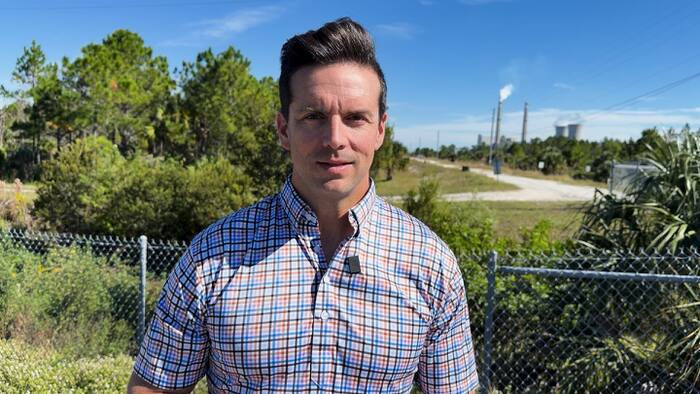
The east side of Orange County doesn’t have a skyline. It has smokestacks.
The Stanton Energy Center, run by the Orlando Utilities Commission, sits a few miles from the restaurants and homes of Avalon Park. It burns natural gas and coal, and it has solar panels on site. Most people nearby say they rarely think about it.
“From zero to 10?” Avalon Park resident Manouchka said when asked how often she thinks about the plant. “Minus five. It does not register.”
But what happens at Stanton is changing, and not in the direction OUC had previously planned.
OUC initially planned to put one of Stanton’s two coal-fired units into an extended shutdown at the end of May 2026, part of the utility’s long-running move away from coal.
Then the federal government stepped in. On June 4, U.S. Energy Secretary Chris Wright signed an emergency order requiring OUC to keep that coal unit, known as Stanton Unit 1, available to run. The Department of Energy later extended the order through Nov. 30. Click here to see the order.
“The Department of Energy said, hey, let’s pump the brakes on this and ensure that we have enough capacity to meet our current needs,” said Orlando Alancastro, OUC’s vice president of transmission.
The emergency order points to the growth of data centers. It says that in Florida, “projections for resource and transmission growth lag behind what is needed to support new data centers and other large loads.”
“As of April 2026, eight data centers are planned for construction in Florida,” the order says.
OUC’s CEO, Clint Bullock, raised the same concern at a public workshop earlier this month.
“The size of these hyperscalers is like nothing we’ve ever seen. You can’t forecast it into your traditional forecasting. That’s why this is a concern,” Bullock said. Hyperscalers are the massive data centers run by companies such as Google and Amazon.
OUC says data centers are only part of the picture. The utility points to faster-than-expected growth in electric vehicles, more manufacturing, and a lack of new power generation across Florida.
“There hasn’t been a whole lot of new generation that has been built in the last several years,” Alancastro said.
Recent winter and summer weather events have also increased peak energy demand. As a result, OUC is increasing its reserve margin from 15% to 20% to help ensure reliable service during periods of high demand.
At the workshop, OUC proposed its Electric Integrated Resource Plan, a 20-year roadmap, which does not take coal off the table. The workshop presentation is posted on OUCFuturePlanning.com.
Under the plan, Stanton Unit 1 comes back online in 2028, converted so it can run on either coal or natural gas. Stanton Unit 2 gets the same conversion in 2029. The plan does not set an end date for burning coal at Stanton.
“It leverages existing infrastructure. The cost to convert those units are far more economical than building a new resource,” Alancastro said.
The plan also adds 150 megawatts of solar and 100 megawatts of battery storage by 2035. A gas plant with carbon capture and 345 megawatts of nuclear power are penciled in for the 2040s. Castro described those as placeholders that could change as technology develops.
OUC says the plan still meets its goals of cutting carbon emissions 50% by 2030 and 75% by 2040, compared with 2005 levels.
Coal’s share has already shrunk. According to OUC, coal made up 41% of its generating capacity in 2019 and 27% in 2025. Solar grew from less than 1% to 11% over the same period.
What it means for your bill
OUC says the plan would raise bills by about 1% a year for the next 5 years.
There is some short-term relief. OUC is proposing a fuel charge cut that would lower a typical residential bill, based on 1,000 kilowatt-hours a month, by about $5 starting in April 2027.
Avalon Park resident Jenna Egensteiner said she supports cleaner energy but wants the details. “Cleaner energy is obviously where you want to go. It’s just how, when, how much, for what,” she said.
How to weigh in
OUC is taking public comments on the plan through Dec. 4 at oucfutureplanning.com. The OUC board is scheduled to vote on the plan and the proposed fuel cut on Dec. 15.
