

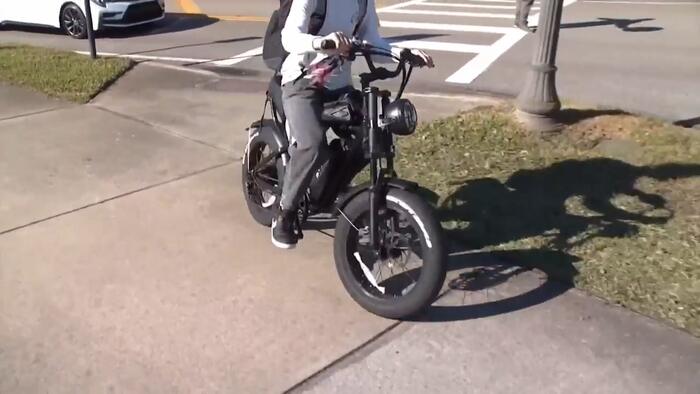
DeBary could become the latest Central Florida city to put restrictions on e-bikes. City leaders are discussing new rules that would set speed limits, require helmets for younger riders and impose fines for violations.
The growing use of electric bicycles, scooters and similar devices has created a need for clearer regulations — particularly near schools, on sidewalks and along shared-use trails.
Some Central Floridians see micromobility as the wave of the future.
“I believe it is a good way of transportation for people that cannot afford a car, especially the young folks,” said Jim Hunter of Deltona.
But many also agree that riders, drivers and pedestrians need to find a way to coexist safely.
“I think that they’re a great addition. It’s a great progress of transportation. Just there needs to be some precautions involved, because if not, then if you just get people doing whatever they want,” said John McFarland of DeBary.
DeBary is working to make that a reality.
For the past six months, city staff has been working with the Volusia County Sheriff’s Office, Orange City and the Orange City Police Department to develop a coordinated regulatory approach. The agencies reviewed proposed language, discussed enforcement concerns, evaluated ordinances from other Florida municipalities and worked toward consistent standards across jurisdictional boundaries.
The goal is to reduce confusion for riders and help officers enforce regulations in adjoining communities.
“And it’s really our first blush to try to curb some of the misbehavior that’s occurring on e-bikes,” said Carmen Rosamonda, DeBary city manager.
Rosamonda said the ordinance is heavily focused on slowing riders down.
“We set up three speed limits: five miles an hour for an active school zone. So you don’t run over any kids or anything else in that regard. Ten miles an hour on sidewalks so that we can have a safe sidewalk with a mix between golf carts and pedestrians. And then on our state trails, 15 miles an hour,” Rosamonda said.
According to the proposed ordinance — Ordinance No. 09-2026 — those speed limits apply specifically when school warning signals or flashers are activated in school zones. The ordinance also includes yielding requirements and compliance with crossing-guard instructions.
Riders would be required to audibly warn pedestrians before passing. The proposed rules would also restrict riding in signed recreational facilities, event spaces and other pedestrian-oriented areas. Electric motorcycles would be prohibited entirely from sidewalks, bicycle paths and shared-use trails.
Those under 16 would be required to wear helmets, and authorized government personnel performing official duties would be exempt from certain provisions.
Violations carry a steep price tag — $100 for a first offense, $250 for a second within 12 months and $500 for a third or subsequent offense within a year. The ordinance also includes impoundment provisions.
Still, Rosamonda suggested enforcement may start gently.
“I’m sure there’s going to be a whole series of warnings that usually that’s how the captain and the sheriff work is that we’ll provide some warnings to try to change behavior,” she said.
The proposed ordinance also draws clear distinctions between device types — defining Classes 1, 2 and 3 electric bicycles separately from electric motorcycles, along with micromobility devices, recreational facilities and shared-use paths.
The city would also have the authority to designate additional trail restrictions with public notice and signage. Conforming amendments to DeBary’s existing micromobility-sharing program requirements are also included.
City leaders will vote on the first reading of the ordinance tonight. If it passes a second reading, the restrictions will go into effect immediately.
